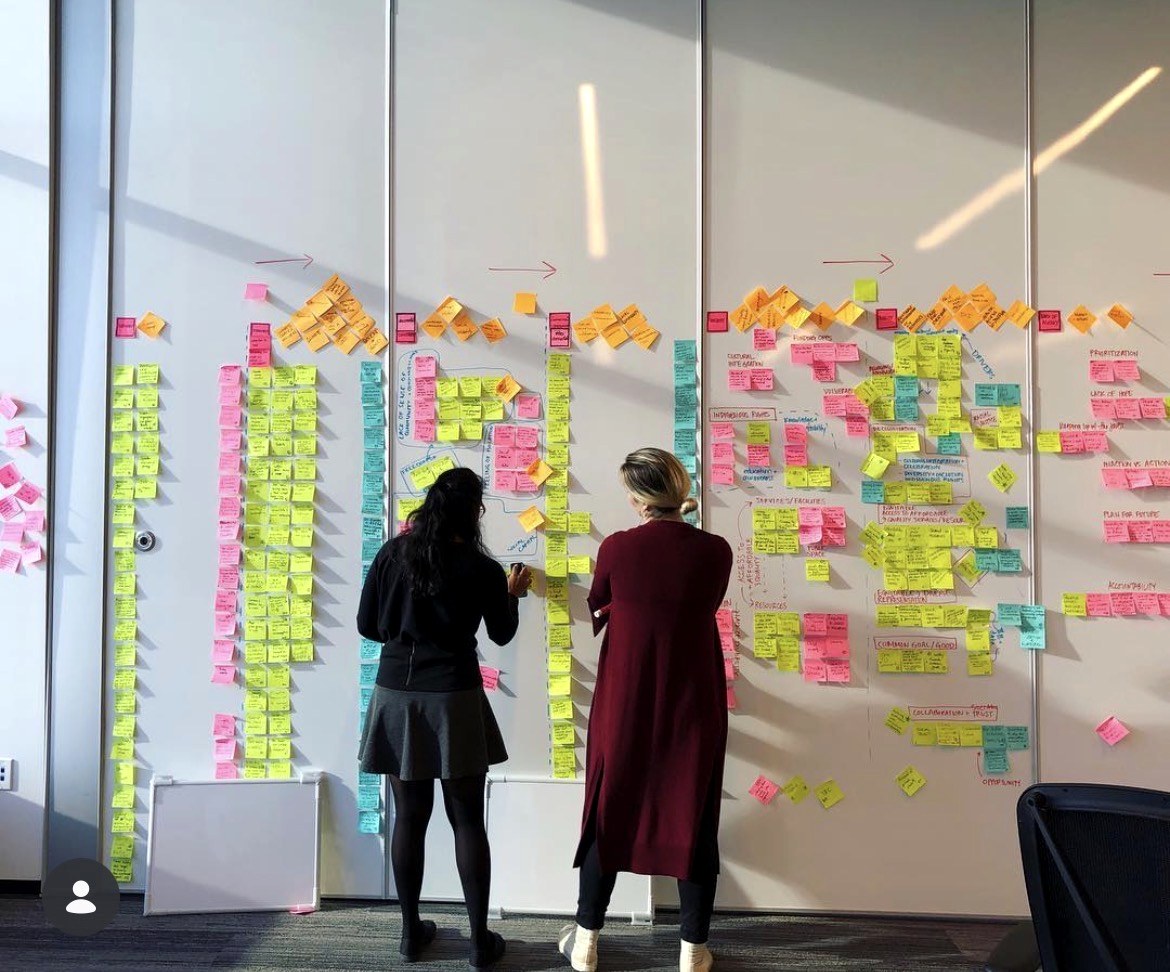
Research synthesis in progress — patterning and mapping findings across all bodies of research from Toronto's two-year resilience consultation process.
Distilling two years of research and consultation across a city of three million people into the strategic recommendations that shaped Toronto's first resilience strategy.
The Rockefeller Foundation's 100 Resilient Cities initiative funded resilience offices in cities across the world — providing resources, expertise, and a structured process for each city to develop its own resilience strategy, grounded in local context and community voice.
Toronto joined the network in 2016. Over the following three years, the city's Chief Resilience Officer led an ambitious process: a two-year engagement and research campaign involving over 8,000 Torontonians, 10 Resilience Hubs, policy experts, community leaders, and cross-disciplinary design and foresight practitioners.
For the strategy's final and most critical phase — distilling the full body of research into coherent insights and actionable strategic recommendations — Toronto's Chief Resilience Officer engaged OCAD University's CO (Continuing Education and Research) unit, where I worked as a Design Strategist, in partnership with KerrSmith, a Toronto-based strategic foresight firm.
Our mandate: design and facilitate a series of intensive research synthesis engagements, run design thinking and foresight workshops with the resilience office leadership team, and help the city find the signal in a vast, multi-layered body of public consultation data.
This Strategy is meant to light a spark — to drive action at the City and from business, academia, non-profit organizations, and residents to build a city where everyone can thrive.
By the time we were engaged, the research base was vast and multi-dimensional — workshops, neighbourhood conversations, telephone townhalls, philanthropic engagement. Our work was to find the architecture underneath it all.
We ran intensive working sessions with the Chief Resilience Officer and his team of policy experts and designers — bringing design thinking and futures methods to bear on a policy challenge at city scale. These sessions helped the leadership team clarify priorities, name tensions, and move from findings to frameworks.
We designed and guided a series of structured synthesis sessions — pattern-finding exercises that mapped findings across all bodies of research. Working wall by wall with sticky notes, affinity diagrams, and clustering methods, we surfaced the themes, tensions, and opportunities embedded in thousands of data points from across the city's communities.
From the synthesis, we translated patterns into strategic language — working with the resilience office to shape the insights into a coherent set of recommendations aligned to the six resilience challenges the city had identified. The output became the strategic foundation for the final published strategy.
The breadth of the engagement process was one of the most ambitious in the city's history. Our synthesis work drew on five distinct streams of public and stakeholder input — each representing a different community of Torontonians, each carrying its own texture of concern, priority, and aspiration.
Structured workshops focused on the intersection of climate resilience and equity — surfacing how environmental shocks and stresses fall unevenly across Toronto's communities and what a just response looks like.
Participatory sessions on the Strategy's vision and proposed actions — helping the city understand which priorities resonated, which felt missing, and how residents imagined a resilient Toronto in practice.
Community-led conversations facilitated by members of the Local Champions program — neighbourhood leaders who brought the city's engagement process directly into the communities that government processes often miss.
A large-scale telephone townhall that extended the engagement process to residents who couldn't attend in-person events — broadening the reach of consultation and ensuring representation across Toronto's diverse geography.
A collaboration with the Toronto Foundation involving 10 Resilience Hubs across the city and 70+ next-generation philanthropists — connecting civic investment, community infrastructure, and resilience thinking in a way no single workshop process could.
Developed through the synthesis of extensive public and stakeholder engagement, these six resilience challenges represent Toronto's most pressing issues and most significant opportunities — each one a commitment about the kind of city Toronto wants to be.
People have access to the things they need to thrive. Resilience without equity is incomplete — the strategy centres the most vulnerable as both a moral and practical imperative.
Coordinated, large-scale climate mitigation and adaptation efforts. Toronto faces flooding, heat, and the long-term consequences of a changing climate — requiring systemic, not incremental, response.
Everyone is engaged in decision making and there is a high level of trust in government. Resilience requires a city where residents feel their voice matters — and where that voice shapes decisions.
Silos are broken down and communities work together to solve problems locally. Neighbourhood-level social cohesion is one of the strongest predictors of resilience in a crisis.
Diverse housing solutions ensure broad affordability. A city where people can afford to live is a city that can maintain its communities, its workforce, and its social fabric under pressure.
Multiple reliable, affordable, accessible, and safe mobility options. Resilient movement means no single point of failure — and access to mobility that doesn't depend on wealth or able-bodiedness.
The strategy's actions are organized into three focus areas — each one addressing a different layer of what makes cities resilient: the social fabric that holds communities together, the infrastructure that sustains daily life, and the governance systems that make coordinated action possible.
The most immediate layer of resilience is social — the capacity of communities to support one another, to act before a crisis, and to recover after one. Priority actions address housing, neighbourhood self-sufficiency, and poverty elimination.
Physical systems — flood infrastructure, buildings, transit, food — must be able to absorb shocks and continue functioning. Priority actions address flooding and heat, building resilience, and mobility across the city.
Resilience must be embedded in how the city makes decisions — not layered on top. Priority actions address civic trust, equity integration into planning, Indigenous leadership, and institutionalizing resilience practice city-wide.
My work on Toronto's Resilience Strategy heavily informed my Master's research partnership with the City of Toronto Resilience Office, the Dalla Lana School of Public Health (University of Toronto), the CIHR-funded Healthy and Resilient Cities Project, and community resilience leaders within the 100 Resilient Cities (Rockefeller Foundation) network. The collaboration focused on co-creating strategies that embedded justice, equity, and inclusive governance into resilience planning at the city scale.
The research synthesis methods, systems thinking, and strategic frameworks developed through this work built the theory of Dream Capital — a generative approach for how private capital, community resilience, and urban development can be aligned toward more equitable futures. The throughline between civic resilience, neighbourhood-scale investment, and the communities most exposed to systemic risk remained central to what followed.